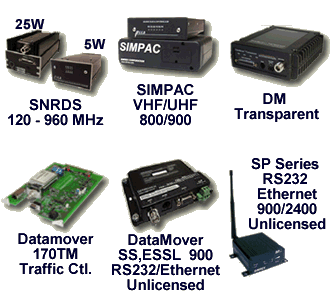
ARIA Wireless System III
A Solution for ATM's, POS Terminals, Retail Outlets and Lottery
Terminals
 Data Sheets: Data Sheets:
General Description:
SIMREX's System III wireless data network incorporates the latest
in digital, Radio Frequency (RF) and software development. System
III represents the third generation of CEMA-based technology products.
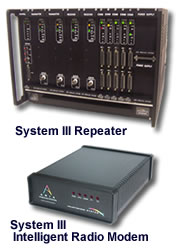
Intelligent Radio Modems (IRM's) are the customers' primary communication
devices, which provide the radio interface between host computers,
terminals and data entry devices at different geographic locations.
Communications between nodes is over a shared radio channel utilizing
the CEMA (Collision Eliminating Multiple Access) protocol.
System III IRM's replace conventional modems and telephone lines
for local loop communication. System III IRM's can support the existing
requirements of dissimilar terminal equipment, varying baud rates,
and protocols. IRM's can operate in a broad range of frequency bands
including the 400-512 MHz or 805-960 MHz bands.
User data, in packet radio format, is sent by CEMA over the RF channel
at 9.6 Kpbs or 19.2 Kbps to its proper destination. Each System III
IRM on the network can hear every transmission, but will respond
to messages only specifically addressed to it.
Collision Eliminating Multiple Access (CEMA)
Collision Eliminating Multiple Access (CEMA) is a patented (U.S.
patent 4,907,224) channel access protocol, designed specifically
for transaction-orientated data. Unlike radio-based Carrier Sense
Multiple Access (CSMA) protocols, CEMA achieves maximum data throughput
by avoiding packet re-transmissions caused by collisions of simultaneous
transmissions by different network participants.
CEMA allows Systems III to use as much as 85% of the link capacity
for mission-critical user data communication, as compared with the
35%-50% characteristic of mobile systems, as well as support multiple
protocols within the same network. PDDN currently supports most major
standard industry protocols. The modular design of the CEMA software
system makes modifying or adding protocols a straightforward process.
By supporting multiple protocols and network topologies, CEMA eliminates
the need for many users to undertake major and costly hardware and
software system reconfiguration. This flexibility allows PDDN to
be far more user-friendly than other public wireless networks. Unlike
every other public wireless network today which require the user
to modify their information system architecture to interface with
the network, CEMA enables PDDN to adapt to the user.
The major architechtural features of CEMA are as follows:
Time Slotted Contention:
- Minimal network time is divided into time slots to separate data
transmission time from node contention time (request to tranmsit).
- Contention period represents only a small portion of the overall
transmission time.
- When participants contend, they do so only with a short contention
message, not the data packet itself.
Floating Reservation List:
- Once a participant with data to send successfully contends for
the network, its address is placed on a reservation list.
- The next participant on the list is given the opportunity to
transmit in the next data slot.
- In a heavily loaded network, the contentions decrease since most
of the participants are on the reservation list.
- Less time is devoted to contending and more to data transfer,
yielding higher network efficiency when it is needed most.
- The reserveration list only exists if there are simultaneously
contentding nodes.
Silent Acknowledgements:
- In transaction environments, data transfers are typically two-way:
a query (database access, card number, purchase amount, etc.) and
response (database record, authorization, confirmation etc.).
- This characteristic is exploited to reduce the number of acknowledgement
(SNAC) packets on the netowrk.
- A receiving unit normally SNAC's the data sent, but if it in
turn has data to send (a response to a query), the acknowledgement
is included in a single byte of the response data packet, eliminating
the need for an entire SNAC packet transmission.
- When multiple data packets are to be acknowledged, the counts
within a single SNAC byte performs this function, similar to
the Nr and Ns count fields in X.25 and SDLC
Supported Communication Protocols:
- TCP/IP
- X.25 Level 3
- SLIP/PPP
- IBM 3270
- Asynchronous
- SNA / SDLC
- HDLC
- ISO / Burrough's Poll Select
- Others
System III IRM (Intelligent Radio Modem Architecture)
Remote terminal connectivity is provided by System III IRM's configured
as Terminal Servers. The IRM's provide the network access to
the Network Intelligent Repeaters via the System III CEMA protocol.
Connection between terminal and the System III terminal Server
is via RS-232 serial data communications. The speeds of the
IRM DCE ports are configurable and independent of the network baud
rate. Connection between the IRM's and the antenna is via coaxial
transmission line. The optimal antennas to utilize are high
gain directional Yagi that provide high forward gain to the Network
Intelligent Repeater.
The IRM delivers performance features not otherwise available through
radio networks:
- Concurrent, multi-protocol support using the same CPE.
- Remote software download capability.
- Remote software & amp; protocol reconfiguration.
- Fully synthesized frequency selection.
- Remote hardware/software configuration and monitoring.
The System III IRM transceiver subsystem is a half duplex, digitally
synthesized radio that operates in most frequency ranges with 12.5
kHz or 25 kHz channel spacing available in 9.6 Kbps or 19.2 Kbps.
The CPU subassembly contains the microprocessor, FLASH memory, input/output
and firmware to support CEMA protocol, local protocol emulation,
diagnostics, configuration, and network management functions equipped
with a db-25F connector.
Redundant, Network Intelligent Repeater (NIR) Architecture:
Each metropolitan region is serviced by at least one Network Intelligent
Repeater (NIR) that provides the RF coverage over the region. It
can also provide the gateway into the network where the repeater
and customer point-of-presence (POP) are co-located.
The Redundant Network Intelligent Repeater is a fault-tolerant unit,
consisting of two transmitters, two receivers, two AC power supplies,
Control Card and Comm Card. A microcontroller, located on the Control
Card, monitors the built-in test status of all the subassemblies
and switches upon detection of a failure. There is a 'Fail Safe'
mode that allows the unit to still operate in case of a Control Card
fault. The Comm Card contains the microprocessor, FLASH memory, input/output
and firmware to support the CEMA protocol, local protocol emulation,
diagnostics, configuration, and network management functions. The
physical interface to the Comm Card is RS-232 configured as DCE on
a dB-25S connector. The protocol physical and data link parameters
are independently configurable of the RF network. Configurable parameters
include data encoding and clocking options to match the interface
at the connected DTE.
Remote management of the Repeater is available via the front-panel
RS-232 connector or over the CEMA network. The front panel interface
supports a simple ASCII-based command language that can be accessed
by any terminal emulator program locally or by remote dial-up modems.
Through the installation of a Communications card, management can
be supported by a remotely located System III Network Manager. This
architecture provides on-line control over the RF network while allowing
a secondary path via another RF link or dial-up modem for backup
communication.
Redundant Multi-Comm Host Configuration:
For system configurations that include a host or hub site that
concentrates the circuits, the System III Redundant Host Server configuration
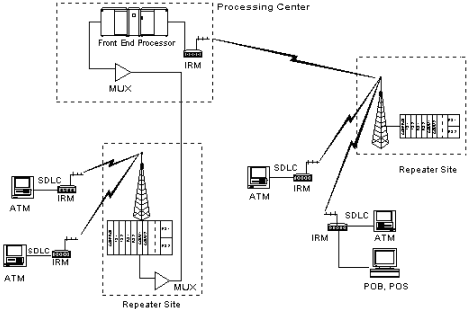
can provide a fail-safe solution for the system feeds. As shown figure
2, this unit provides the redundant capability as a repeater, but
in a remote, half-duplex configuration that allows up to five communication
cards (10 ports) for use at a remote location from the repeater.
With port 1 or Comm card 1 dedicated to the chassis control, this
unit has all the remote command and control capability of a standard
repeater such as transmitter and receiver manual switchover, operational
status, voltage checks, individual card reset, alarm status, alarm rest
and network baud rate configuration.
Network Management:
Management of the ARIA Wireless System III CEMA Network is accomplished
by the System III Network Manager. The Network Manager is a PC-based
software package that operates under the Windows® operating
system and offers complete management, command and configuration
control of a network from one location.
The System III Network Manager connects to the network via the System
III Repeater of any IRM. Various methods of connectivity are available
such as direct to the Repeater and/or IRM, or through remote connections
such as dial-up modems, lease line modems, multiplexors or VSAT terminals.
|